Habitat and Ecology
Bulbophyllum careyanum (the Carey's Bulbophyllum) is a medium-sized, epiphytic orchid native to the Himalaya to Indo-China. Its distribution includes Assam, Bangladesh, Eastern Himalayas, Nepal, Bhutan, Myanmar, Thailand, Laos, and Vietnam. It thrives in evergreen lowland forests and montane forests at elevations from 200 to 2,100 metres. This species is adapted to a cool-to-warm growing regime with high humidity and a distinct seasonal variation.
🌸 Description and Distinguishing Features
This orchid is a sympodial perennial that forms dense clumps.
Pseudobulbs & Foliage: It produces ovoid to sub-cylindrical pseudobulbs (up to 5 cm long) that are slightly grooved and spaced along a stout rhizome. Each pseudobulb is topped by a single, large, leathery, oblong leaf (15-25 cm long).
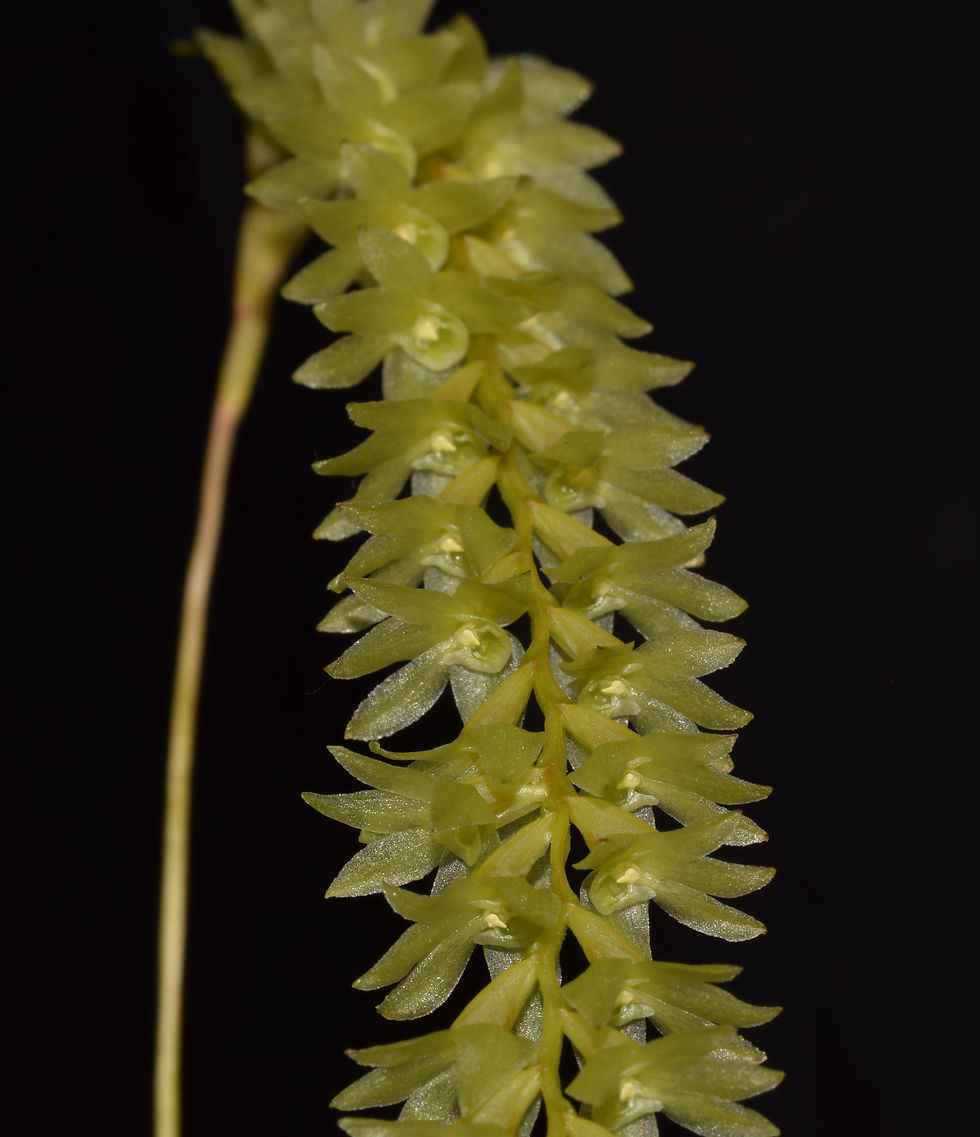
Flowers: The flowers are borne on a long, pendent to arching spike (raceme) that emerges from the base of the pseudobulb. The inflorescence is densely packed with numerous small flowers, forming a cylindrical, "rat-tail" shape.
Aesthetics: The blooms are small (6-10 mm) and typically orange-brown, copper, or yellowish-green, often with purple spots or markings. The lateral sepals are fused at the base, and the dorsal sepal is hooded. The lip (labellum) is small, fleshy, and mobile, often a darker purple or red-brown. The flowers have a distinctive, often unpleasant odour.
Ethnobotany: In traditional medicine in Nepal and India, the pseudobulbs of Bulbophyllum careyanum (and related species like Bulbophyllum neilgherrense) are used as a tonic or to treat various ailments, reflecting the genus's wider ethnobotanical significance in Asia.
Differentiation: Bulbophyllum careyanum is part of a complex of similar species:
Versus Bulbophyllum cupreum: B. cupreum has smaller, more copper-coloured flowers and a more lax inflorescence compared to the dense, cylindrical spike of B. careyanum.
Versus Bulbophyllum crassipes: B. crassipes has a much shorter, thicker inflorescence and more yellowish flowers.
💧 Cultivation and Care
Bulbophyllum careyanum is an intermediate to warm-growing orchid that is relatively easy to cultivate.
Light: Requires moderate shade to bright, filtered light. Avoid direct midday sun to prevent leaf scorch.
Substrate: Best grown in a basket or pot with a moisture-retentive, open mix of bark, sphagnum moss, and charcoal. It can also be mounted on cork if humidity is high.
Watering: Water regularly throughout the year, keeping the medium moist but not soggy. Reduce watering slightly in winter, but do not allow the pseudobulbs to shrivel excessively.
Temperature:
Optimal Daytime Temperature: 20-28 C (68-82 F).
Optimal Nighttime Temperature: A small drop is beneficial, ideally 14-18 C (57-64 F).
Humidity: High humidity (60-80%) and good air circulation are essential to prevent fungal issues.
✨ Unique Features
This orchid is a classic representative of the Bulbophyllum genus, prized for its dense, cylindrical spikes of orange-brown flowers and its robust, clump-forming habit. Its medicinal history adds an extra layer of interest for the ethno-botanically inclined collector.
🏷️ Specifications
Plant Size: Flowering size divisions from our stock plant
Plant Family: Orchidaceae
Plant Passport: A Bulbophyllum careyanum B 140084 C [buyer to use number of the plant label] D GB