🇳🇿 Habitat and Ecology
Freycinetia banksii, known commonly by its Māori name Kiekie, is a robust, woody climbing plant endemic to New Zealand (Aotearoa). It is widespread across the North Island and found in milder, coastal regions of the South Island.
It is a quintessential component of New Zealand's coastal, lowland, and lower montane rainforests, found up to elevations of approximately 900 metres. It is highly adaptable in habit, growing as a dense groundcover on forest floors, tumbling over cliffs, or, most characteristically, as a high-climbing root-climber (lianoid), clothing the trunks of massive forest trees in dense thickets of foliage.
🌿 Description and Distinguishing Features
This species is the only member of the Pandanaceae (Screwpine family) found on the New Zealand mainland, giving it a distinct, almost tropical, prehistoric appearance compared to surrounding flora.
Habit: A vigorous, woody climber that attaches to host trees via strong aerial roots. The stems can reach many metres in length and become rope-like (up to 4 cm diameter) over time.
Foliage: The leaves are arranged spirally in dense tufts at the ends of branches. They are long (60-90 cm), strap-like (ensiform), and arching. The leaf texture is leathery and shiny green, with finely serrated margins and midribs that can be quite sharp to the touch.
Inflorescence & Fruit: Freycinetia banksii is dioecious (separate male and female plants).
Flowers: appearing in spring, the flowers themselves are minute and crowded onto spikes (spadices). The striking feature is the cluster of thick, fleshy, edible bracts (modified leaves) that surround the flower spikes. These bracts are typically white or cream, sometimes tinged with purple.
Fruit: On female plants, the flower spikes develop into oblong, compound fruits (up to 15 cm long) resembling a green corn cob, known as ureure. These turn brownish and soft when ripe in late autumn/winter.
🔬 Taxonomy and Ethnobotany
Taxonomy: The genus is named for Admiral Louis de Freycinet, a 19th-century French navigator. The specific epithet banksii honours Sir Joseph Banks, the botanist on Captain Cook's first voyage.
Ethnobotany (Māori Kai and Raranga): Kiekie is of immense cultural importance to Māori.
Food (Kai): It was a highly prized seasonal delicacy. The succulent, sweet-tasting floral bracts, known as tāwhara, were gathered in spring. The ripe fruit spikes, ureure, were also eaten later in the season, often said to taste like a mix of banana and passionfruit.
Weaving (Raranga): The leaves are a primary resource for weaving. They are harvested, prepared (often by boiling or bleaching in the sun to whiten them), and used to create fine mats, kete (baskets), and especially the intricate lattice-work panels known as tukutuku found inside wharenui (meeting houses).
💧 Cultivation and Care
While common in the wild in New Zealand, Freycinetia banksii is rarely grown as an indoor houseplant internationally due to its size and specific needs. It is sometimes found in botanical garden conservatories.
Light: Requires deep shade to dappled forest light. Direct sun will bleach and scorch the foliage.
Substrate: Needs a rich, moisture-retentive forest floor mix (e.g., bark, leaf mould, compost). Crucially, as a climber, it needs a robust support structure (like a large totem pole or a rough wall) for its aerial roots to grip; otherwise, it will sprawl messily.
Watering: Replicates a rainforest environment. Keep the substrate consistently moist. It does not tolerate drought. High humidity is essential.
Temperature: Cool temperate to subtropical. It thrives in temperatures between 10-25 C (50-77 F). It can tolerate light frosts once established but prefers sheltered spots.
✨ Unique Features
Kiekie is unique for its edible, sweet-tasting floral bracts (tāwhara), a rare trait in temperate forest flora. Its growth habit creates a distinct architectural layer in the NZ forest, bridging the gap between the forest floor and the high canopy with its dense, screwpine-like foliage.
🏷️ Specifications
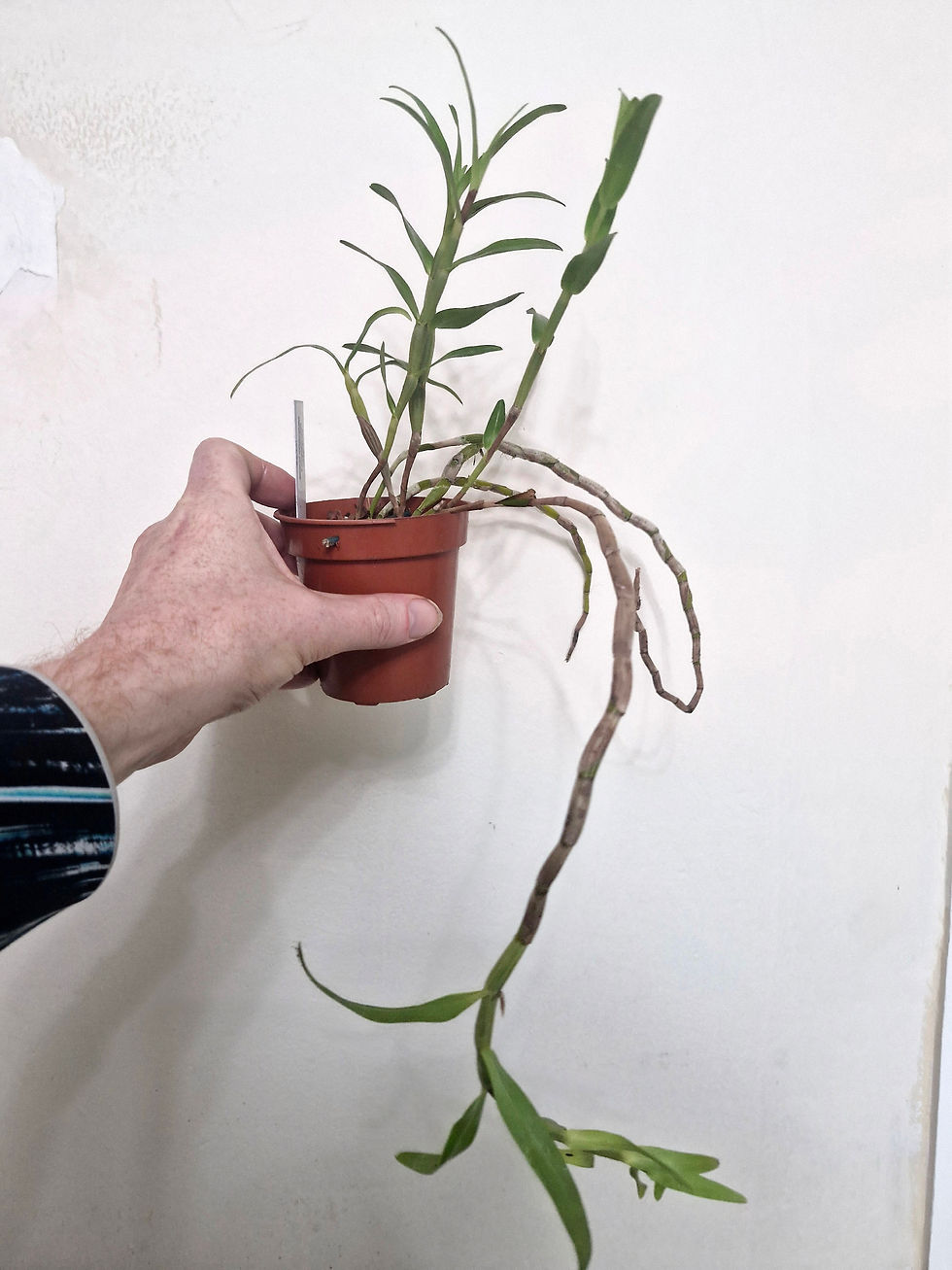
Plant Size: Young seed grown saplings, sewn early 26.
Plant Family: Pandanaceae
Plant Passport: A Freycinetia banksii B 140084 C [buyer to use number of the plant label] D GB