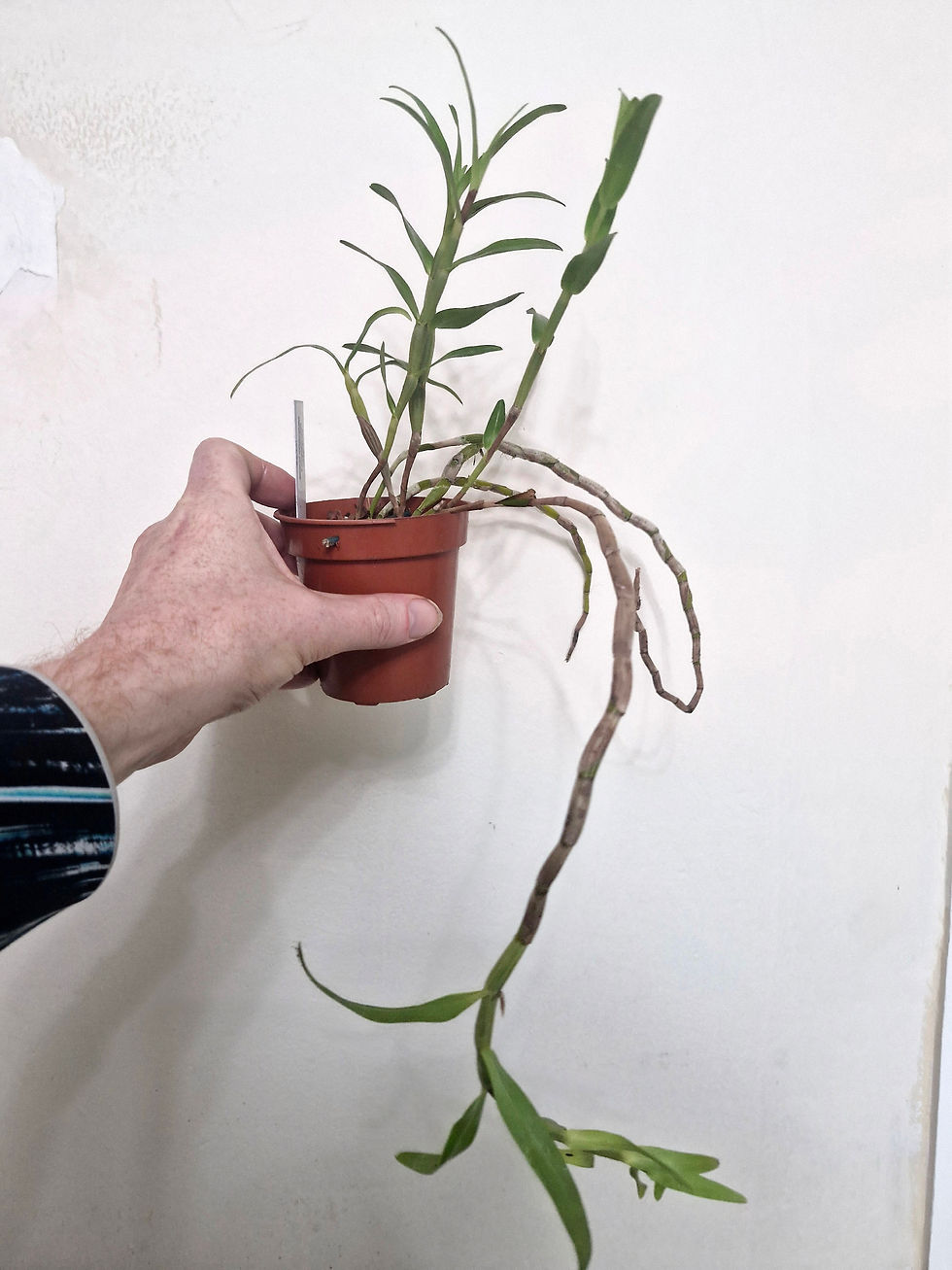
🇨🇴 Habitat and Ecology
Dracula robledorum is an epiphytic orchid endemic to the Western Cordillera of Colombia (specifically the Department of Antioquia). It inhabits cloud forests at elevations ranging from 2,000 to 2,200 metres.
In this cool, mist-shrouded environment, it grows on the lower trunks of trees where humidity is perpetually high and light levels are low. The species is accustomed to constant air movement and moisture without distinct dry seasons.
🌸 Description and Distinguishing Features
This species is a caespitose (clump-forming) perennial typical of the genus, lacking pseudobulbs and relying on ramicauls (stems) to hold the leaves.
Foliage: The leaves are erect, thinly leathery (coriaceous), and narrowly elliptic (15-25 cm long). They are a lush green and keeled at the base.
Flowers: The inflorescence is a horizontal to descending stalk that bears a single, downward-facing flower. This habit usually necessitates growing the plant in a hanging basket so the blooms can emerge freely.
Aesthetics: The flowers are striking for their bold contrast. The sepals are large and triangular, forming a cup at the base. They are typically heavily spotted and suffused with deep purple-black or maroon against a pale, creamy-white background, often appearing nearly solid black at the center. The sepals taper into long, slender purple-black tails (caudae).
The "Monkey Face": Like other Draculas, the arrangement of the petals and lip creates a simian pareidolia. The lip (labellum) is a key identifier: it is white to pale pink, relatively large, and possesses a scopiform (brush-like) texture.
🔬 Taxonomy and Ethnobotany
Taxonomy: Described by Luer and Escobar in 1978, the specific epithet robledorum honours the Robledo family of Colombia, prominent orchid growers and supporters of orchid conservation who discovered the species.
Pollination: Dracula robledorum utilizes fungal mimicry. The lip (labellum) is modified to resemble the underside of a mushroom in both texture and scent (often undetectable to humans but attractive to insects). This attracts fungus gnats (Mycetophilidae) which unwittingly pollinate the flower while attempting to lay eggs.
Ethnobotany:
Horticultural Status: In the orchid trade, D. robledorum is valued as one of the "Black Dracula" due to its intense dark pigmentation. It is a collector's item, primarily found in specialist collections rather than general horticulture.
💧 Cultivation and Care
Dracula robledorum is a cool-growing specialist that requires strict environmental control. It will not survive on a standard windowsill.
Light: Requires deep shade to low filtered light. Direct sunlight is lethal, causing rapid overheating and leaf scorch. Ideally, light levels should be similar to those for deep-shade ferns.
Substrate: Must be grown in a net pot or wooden basket lined with sphagnum moss. This setup allows the pendent flower spikes to penetrate the bottom/sides of the container. Standard pots will trap and rot the flowers.
Watering: The "Golden Rule" for Draculas: Never let it dry out. The moss should be kept consistently wet (like a squeezed-out sponge).
Water Quality: Use rainwater, distilled, or reverse osmosis (RO) water only. These plants are extremely sensitive to dissolved salts and chlorine found in tap water, which cause leaf-tip necrosis.
Temperature:
Optimal Daytime: 16-20 C (60-68 F). Optimal Nighttime: 10-14 C (50-57 F).
Warning: Sustained temperatures above 25 C (77 F) can cause plant collapse.
Humidity: Very High (80-90%+). High humidity prevents the thin leaves from desiccating, but strong air movement is required to prevent fungal rot in the stagnant wet moss.
✨ Unique Features
The defining feature of Dracula robledorum is the intense saturation of its colour. While many Draculas are mottled, the spots on D. robledorum often merge to create a velvety, almost solid blackish-purple face, against which the bright white/pink lip stands out vividly. It is a prime example of the "gothic" beauty for which the genus is famous.
🏷️ Specifications
Plant Size: divisions from our stock plant, produced in the UK. The divisions contain 4+ growths.
Plant Family: Orchidaceae
Plant Passport: A Dracula robledorum B 140084 C [buyer to use number of the plant label] D GB