🇨🇳 Habitat and Ecology
Dendrobium fanjingshanense (the Fanjing Mountain Dendrobium) is a rare epiphytic orchid endemic to South-Central China, specifically found in the Guizhou province. As the name suggests, it is native to the Fanjingshan (Mount Fanjing) region, a UNESCO World Heritage site known for its biodiversity. It grows on tree trunks in subtropical montane cloud forests at elevations ranging from 800 to 1,500 metres. This habitat provides a climate with warm, moist summers and cool, drier winters.
🌸 Description and Distinguishing Features
This orchid is a sympodial, semi-deciduous perennial belonging to the Section Dendrobium (formerly Eugenanthe), closely related to Dendrobium moniliforme.
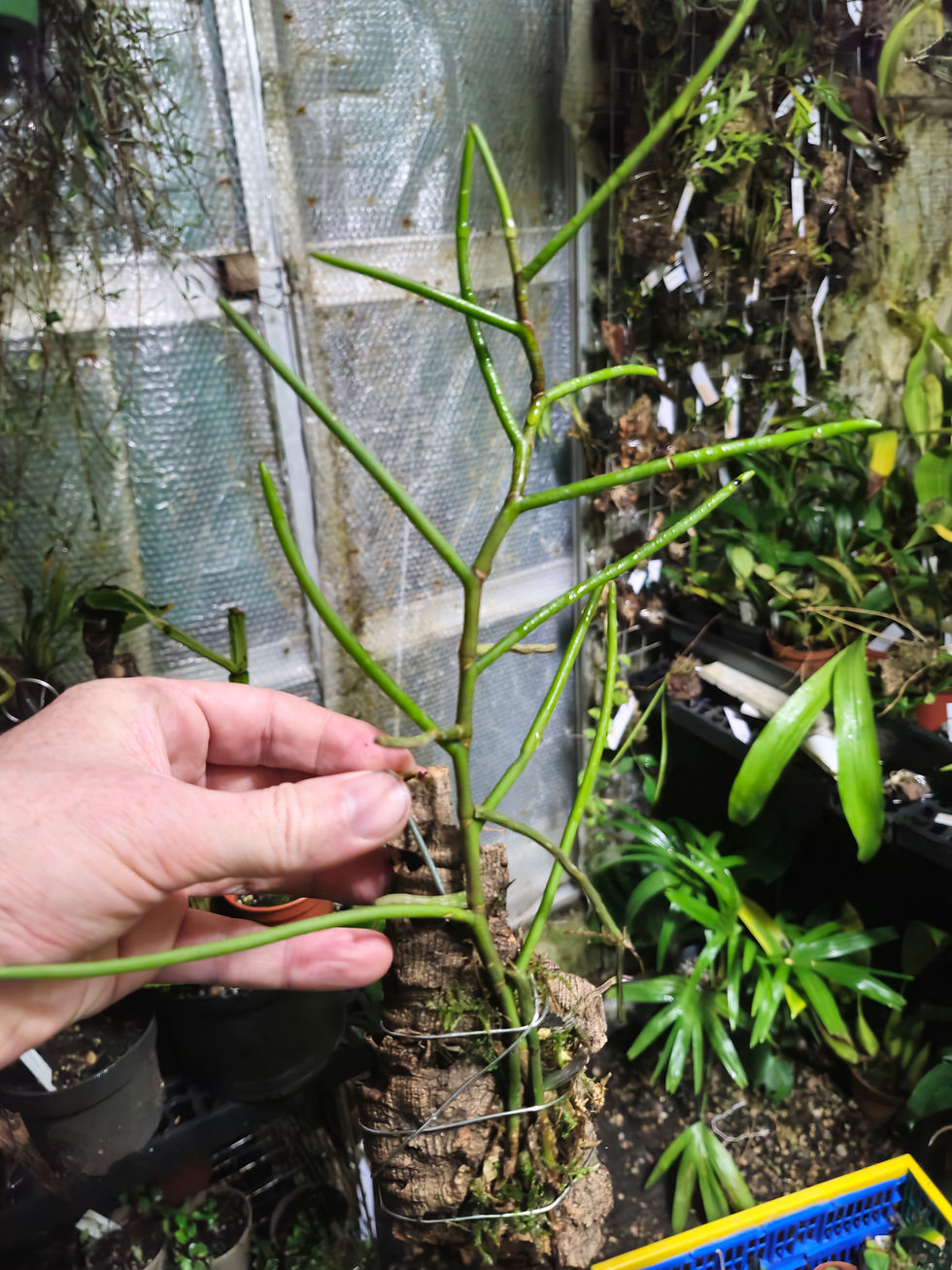
Canes & Foliage: It produces slender, cylindrical, pendulous to ascending canes (stems) that can reach 30-60 cm in length. The stems are segmented, often yellowish-green, and carry linear-lanceolate, leathery leaves (6-8 cm long) along the upper half. The plants are deciduous to semi-deciduous, typically dropping their leaves in autumn/winter before flowering.
Flowers: The flowers are borne on short inflorescences arising from the nodes of the leafless (previous year's) canes. It typically produces 1 to 3 flowers per node.
Aesthetics: The blooms are approximately 4 cm (1.5 inches) wide and are noted for their vibrant colouration. The sepals and petals are a spreading golden-yellow, sometimes described as having lighter yellow edges grading into a deep burnt orange center. The lip (labellum) is broadly ovate and usually features distinct purple striations (stripes) at the base and a tomentose (fuzzy) texture. The flowers are fragrant.
Differentiation:
Versus D. moniliforme: D. moniliforme is typically much smaller (miniature) with white or pale pink flowers, whereas D. fanjingshanense is larger with distinct golden-yellow/orange flowers and purple lip striations.
💧 Cultivation and Care
Dendrobium fanjingshanense requires a seasonal growth cycle typical of Nobile-type Dendrobiums, with a distinct cool, dry winter rest.
Light: Requires bright, filtered light (25,000-35,000 lux). Provide strong light during the growing season to ensure robust canes, but protect from scorching midday sun. High light is essential in winter to induce blooming.
Substrate: Best grown in a small pot (terracotta is good for stability) or mounted if humidity is high. Use a very free-draining mix of medium-grade bark, perlite, and charcoal. The roots are fine and resent sogginess.
Watering:
Summer (Growth): Water abundantly and frequently (3-5 times a week), keeping the medium moist but not wet.
Winter (Rest): Drastically reduce watering once leaves start to yellow in autumn. Water only sparingly (mist or light water every few weeks) to prevent canes from shriveling excessively, but allow the plant to stay dry. This dry stress is crucial for flower bud formation.
Temperature:
Optimal Daytime Temperature: 20-28 C (68-82 F).
Winter Rest Temperature: A cool drop is mandatory, ideally 5-12 C (41-54 F) at night for several weeks to initiate flowering.
Humidity: Moderate to high humidity (50-70%) is preferred during the growing season.
✨ Unique Features
This species is a horticultural treasure due to its rare status (only described in 2001) and its specific endemism to the Fanjing Mountain biodiversity hotspot. Unlike the common white or pink Nobile types, its golden-yellow and burnt orange blooms offer a unique warm colour palette for the cool-growing Dendrobium collection.
🏷️ Specifications
Plant Size: small plants on mounts. Canes 10-15 cm
Plant Family: Orchidaceae
Plant Passport: A Dendrobium fanjingshanense B 140084 C [buyer to use number of the plant label] D GB