🌏 Habitat and Ecology
As an artificial primary hybrid, this specific plant does not have a natural wild habitat. However, understanding its parentage is the key to its cultivation. The seed parent, Papilionanthe pedunculata, is a sun-loving epiphyte native to the wet tropical biomes of Cambodia and Vietnam. The pollen parent, Luisia curtisii, is a closely related epiphyte found across Southeast Asia, including Thailand, Borneo, and the Philippines, typically growing in moist lowland forests. Both parents are denizens of warm, high-humidity, and high-light environments, traits they pass down strongly to their offspring.
🌿 Description and Distinguishing Features
This hybrid is prized by vandaceous orchid collectors for its highly specialized, drought-resistant foliage and unique floral characteristics.
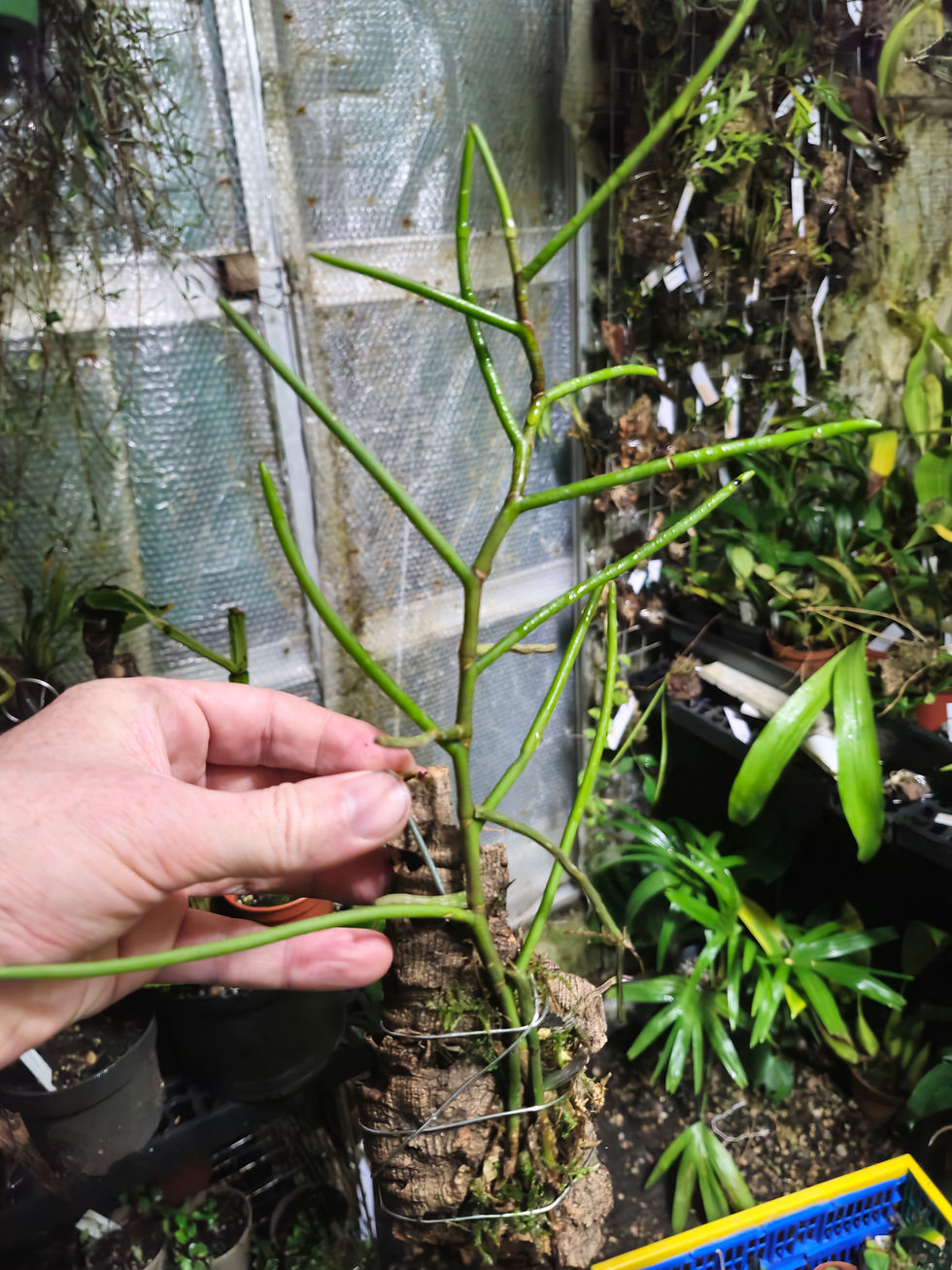
Habit: It is a monopodial, epiphytic orchid featuring a vigorous, upright to scrambling growth habit. Because both parent genera are characterized by specialized foliage, this hybrid produces a distinctively robust, climbing stem.
Foliage: The leaves are terete (cylindrical and pencil-like). This is a distinct evolutionary adaptation inherited from both parents, designed to conserve water and reduce surface area to withstand intense tropical sunlight.
Flowers: While seed-grown crosses can be variable, this primary hybrid generally produces fleshy, starry flowers. It blends the larger, wider floral shape of the Papilionanthe with the distinctively complex, often dark-purple or reddish lip inherited from the Luisia parent.
Roots: It produces thick, vigorous aerial roots along the length of the stem that are designed to grip bark and absorb ambient moisture from the air.
🔬 Taxonomy and Ethnobotany
Taxonomy
In botanical nomenclature, this cross is formally written as Papilionanthe pedunculata × Luisia curtisii. Because it is an intergeneric hybrid (a cross between two distinct but closely related genera within the Vandeae tribe), the resulting offspring belong to the artificially created nothogenus × Papilisia. Please note for your website that the submitted name contained spelling errors; the correct botanical spellings for the parent species according to Kew Plants of the World Online (POWO) are Papilionanthe pedunculata (Kerr) Garay and Luisia curtisii Seidenf.
Ethnobotany
There are no traditional ethnobotanical uses for this artificial hybrid. It is strictly cultivated as a rare, specialist ornamental orchid, coveted by collectors for combining the showy traits of Papilionanthe with the unusual, botanical charm of Luisia.
💧 Cultivation and Care
Due to its terete foliage and vandaceous parentage, this hybrid requires massive amounts of light and root aeration, making its care vastly different from standard houseplant orchids.
Light: Demands very bright light to full morning sun. The terete leaves are specifically adapted to handle high light levels, which are absolutely required to trigger blooming.
Substrate & Soil: Best grown in an open wooden basket without media, or in a highly aerated slatted pot with large chunks of charcoal and coarse bark. It requires massive root aeration and will rot rapidly if placed in standard, moisture-retaining potting soil.
Temperature: This is a warm to hot growing tropical hybrid that deeply resents cold drafts.
Daytime Range: 25–32°C (77–90°F).
Nighttime Range: 18–24°C (64–75°F).
Watering: When grown bare-root in baskets, it requires daily, heavy watering (often twice a day in the peak of summer). It thrives in high ambient humidity (70%+) and needs constant air movement to quickly dry the roots after watering.
✨ Unique Features
× Papilisia (Papilionanthe pedunculata x Luisia curtisii) is a rare, terete-leaved intergeneric hybrid offering unique, starry blooms with a dramatic lip. A highly unusual vandaceous cross that adds serious prestige to your collection.
🏷️ Specifications
Plant Size: (user input)
Plant Family: Orchidaceae
Plant Passport: A Papilionanthe pedunculata x Luisia curtisii B 140084 C use the number written on the plant label D GB