🇨🇴 Habitat and Ecology
Dracula bella (the Beautiful Dracula) is a spectacular epiphytic orchid native to the Western Cordillera of Colombia (specifically the Department of Risaralda). It inhabits dense, wet cloud forests at elevations ranging from 1,700 to 2,000 metres. In this environment, it grows on tree trunks in deep shade, constantly bathed in cool mists and high humidity, experiencing very little seasonal variation in temperature or moisture.
🌸 Description and Distinguishing Features
This species is widely considered one of the finest and most showy members of the genus Dracula.
Habit: It is a robust, caespitose (clump-forming) epiphyte without pseudobulbs.
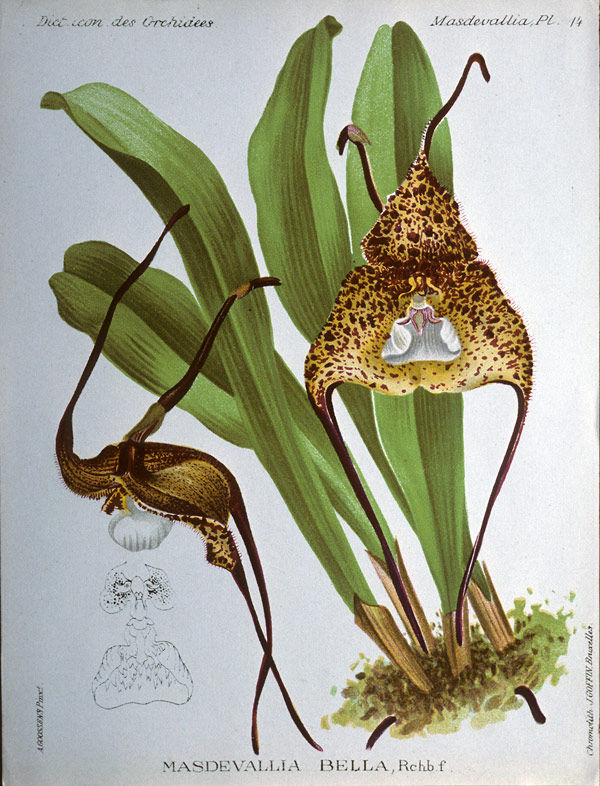
Foliage: The leaves are large, erect, and thinly leathery (15-25 cm long), narrowing into a distinct petiole at the base. They are typically a dark, rich green.
Flowers: The flowers are borne singly on long, pendent inflorescences that hang downwards (often growing through the substrate), necessitating a hanging basket. The blooms are large (15-25 cm tip-to-tip) and widely opening.
Aesthetics: The sepals are triangular and fused at the base to form a cup, tapering into extremely long, reddish-brown tails (caudae). The base colour of the sepals is creamy-yellow or buff, densely spotted and suffused with chocolate-brown or crimson-red, giving a dramatic mottled appearance. The lip (labellum) is a striking feature: it is large, shell-like (scopiform), and pure white, providing a stark contrast to the dark sepals. The mobile lip is flexibly hinged, wiggling with the slightest breeze.
🔬 Taxonomy and Ethnobotany
Taxonomy: The name Dracula means "Little Dragon" (referring to the face-like flower), and bella means "beautiful" in Latin. It belongs to the subtribe Pleurothallidinae.
Pollination: Like its relatives, D. bella mimics fungi. The lip resembles the gills of a mushroom (both visually and possibly in scent) to attract fungus gnats (Mycetophilidae) for pollination.
Ethnobotany:
Horticultural Status: While not used medicinally, D. bella holds a "holy grail" status in the orchid collecting world. It is often cited as the gateway species that convinces growers to attempt the difficult Dracula genus due to the sheer size and boldness of its "monkey face" blooms, which are significantly larger than the type species Dracula chimaera.
Cultural Symbolism: In its native Colombia, Dracula orchids are local icons of the cloud forest biodiversity, though they are often associated with mystery due to their dark colouration and shade-dwelling habit.
💧 Cultivation and Care
Dracula bella is a cool-growing specialist that demands specific conditions. It is arguably one of the more forgiving Dracula species regarding temperature, but still strict compared to standard orchids.
Light: Requires deep shade to low filtered light (800-1,500 foot-candles). Direct sun causes rapid leaf burn and overheating.
Substrate: Must be grown in a hanging basket (mesh or wooden slats) lined with sphagnum moss. This allows the pendent flower spikes to emerge from the bottom or sides of the pot. Standard pots will trap the flowers inside the soil, causing them to rot.
Watering: Keep constantly wet. Never allow the medium to dry out. High-quality water (rainwater or RO) is essential; tap water salts will cause necrotic leaf tips.
Temperature:
Optimal Daytime: 18-24 C (64-75 F).
Optimal Nighttime: 10-14 C (50-57 F).
Note: It can tolerate brief rises to 26 C, making it slightly more heat-tolerant than high-elevation species like D. vampira, but it resents heatwaves.
Humidity: Extremely High (80-90%+). Good air movement is vital to prevent fungal and bacterial rots in such wet conditions.
✨ Unique Features
The large, pure white, shell-shaped lip is the signature trait of Dracula bella. While many Draculas have small or dark lips, the massive white lip of D. bella stands out like a beacon against the dark chocolate-spotted sepals, creating a "face" that is less sinister and more "clown-like" or "beautiful" than its cousins.
🏷️ Specifications
Plant Size: (user input)
Plant Family: Orchidaceae
Plant Passport: A Dracula bella B 140084 C [buyer to use number of the plant label] D GB