🌏 Habitat and Ecology
This orchid is an artificial primary hybrid, created horticulturaly by crossing two distinct species of Dendrobium native to Southeast Asia and Southern China.
To understand its ecological needs, we look to its parents:
Dendrobium ellipsophyllum: A widespread species found from Myanmar to Vietnam and Southern China, inhabiting lowland evergreen forests and primary montane forests at elevations from 300 to 1,300 metres.
Dendrobium sinense: A warm-growing species endemic to Hainan island, China, found in primary forests at lower elevations between 500 and 800 metres.
The resulting hybrid combines these genetics, creating a plant well-suited to warm-to-intermediate tropical conditions, mimicking the seasonally wet forest canopies of its ancestry.
🌸 Description and Distinguishing Features
This hybrid is a compact, epiphytic orchid that blends the distinct morphological features of its two parents from different sections of the genus (Distichophyllae and Formosae), making it a highly desirable collector's plant.
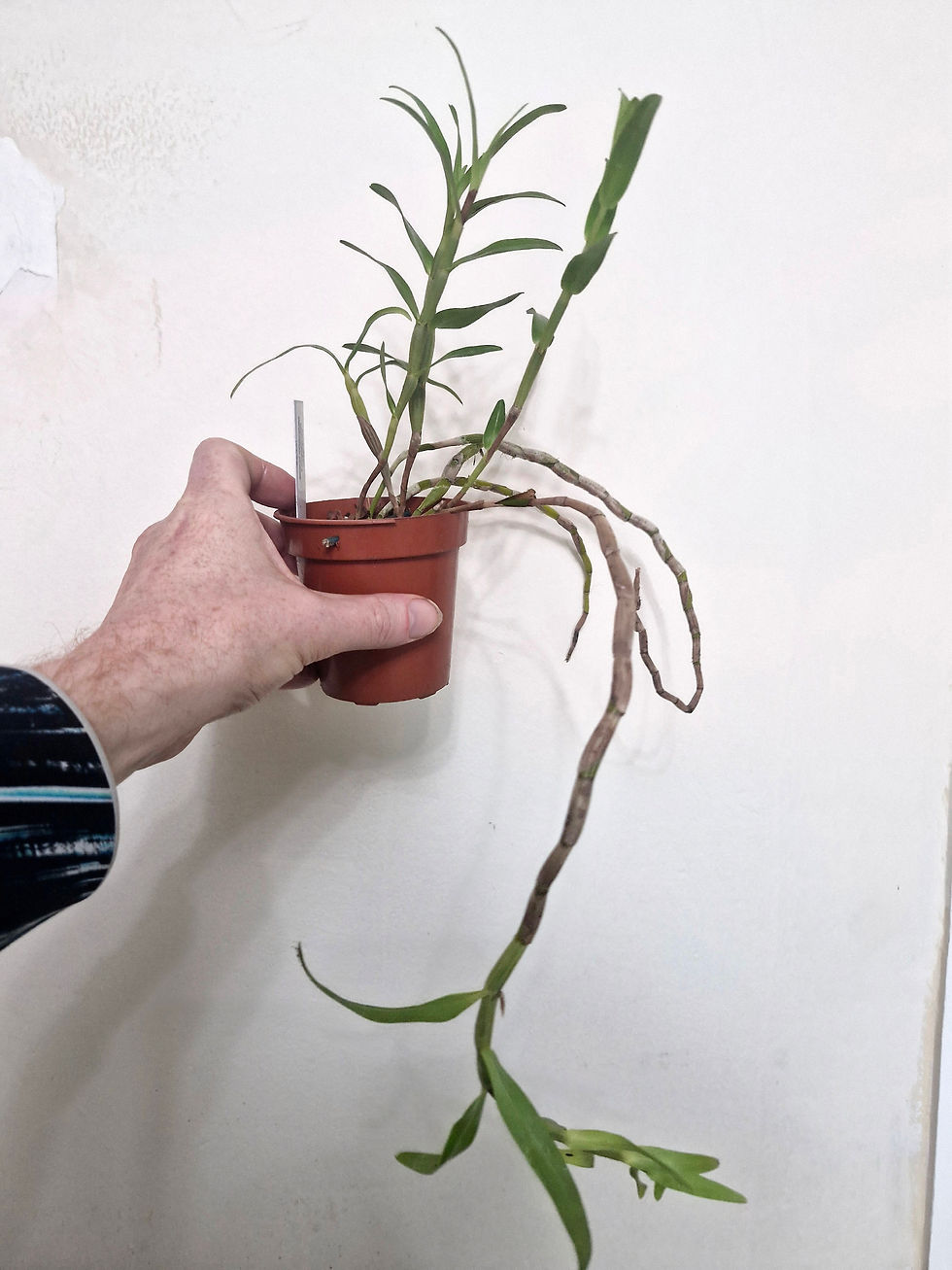
Habit: The plant produces slender, cane-like stems that tend to be arching or semi-pendulous, rather than strictly erect. It typically typically inherits the short, black hairs (nigrohirsute) on its canes and leaf sheaths, a characteristic trait of the D. sinense parent.
Foliage: The leaves are arranged oppositely along the stem (distichous). They are generally leathery (coriaceous) and elliptic in shape.
Flowers: The blooms arise from the upper nodes of the canes. While hybrids vary, this cross generally produces flowers with tepals ranging from creamy-white to pale greenish-yellow. The defining feature is the lip (labellum), which is intricately marked with bold, dark red to maroon veins and blotches—a dominant trait from D. ellipsophyllum—contrasting sharply with the lighter petals.
Fragrance: Both parents are highly aromatic. D. ellipsophyllum scents of honey/beeswax, while D. sinense has a fresh citrus fragrance. The hybrid is typically strongly fragrant, offering a complex, pleasing blend of these notes.
🔬 Taxonomy and Ethnobotany
Taxonomy: This is a horticultural primary hybrid, scientifically denoted as Dendrobium ellipsophyllum × Dendrobium sinense. It represents an intrageneric cross between Section Distichophyllae and Section Formosae (the black-haired Dendrobiums).
Ethnobotany: As a modern horticultural creation, this specific hybrid has no traditional uses, though its parent species have long histories of botanical appreciation in their native Asian ranges.
💧 Cultivation and Care
This hybrid is generally robust and adaptable, suitable for intermediate to warm orchid growing areas. Its semi-pendulous habit makes it ideal for baskets or mounts.
Light: Requires bright, filtered light (similar to Cattleya levels). Insufficient light will result in weak canes and failure to flower.
Substrate: Due to its arching canes and epiphytic nature, it often displays best when mounted on cork or tree fern, or grown in a hanging basket with a highly aerated mix (e.g., medium-grade bark and perlite). It dislikes soggy, compacted roots.
Watering: It originates from monsoon climates. Water copiously during the active growing season (spring and summer), allowing the roots to approach dryness between waterings.
Seasonal Pattern: In winter, growth slows. Reduce watering significantly during this cooler period—providing just enough to prevent the canes from shrivelling—to induce flowering.
Temperature: It is a warm-to-intermediate grower that benefits from a day/night temperature differential.
Daytime: 22-28 C (72-82 F).
Night time: 15-20 C (59-68 F).
Humidity: High humidity (ideally 60-80%) with good air movement is important for healthy growth.
✨ Unique Features
The defining characteristic of this hybrid is the aesthetic balance it achieves. It combines the pristine cream/white background and black-haired canes of the Formosae section with the dramatic, intricate red lip markings and distinct honey-scent notes of D. ellipsophyllum, all on a plant of manageable size.
🏷️ Specifications
Plant Size: (user input)
Plant Family: Orchidaceae
Plant Passport: A Dendrobium hybrid B 140084 C [buyer to use number of the plant label] D GB