🌎 Habitat and Ecology
Marcgravia rectiflora (often misspelled as rectifolia) is a tropical climbing plant with a widespread native range spanning from Central America down to Peru, and across various islands in the Caribbean, including Cuba and Puerto Rico.
It is a denizen of humid tropical rainforests. In these environments, it thrives as a hemiepiphyte, starting its life climbing up tree trunks in the shaded understory. It requires consistently high humidity and is adapted to the warm, moist conditions of the jungle.
🌿 Description and Distinguishing Features
This member of the Marcgraviaceae family is highly prized in horticulture, particularly by terrarium and vivarium enthusiasts, due to its unique shingling growth habit and distinct foliage.
Habit: It is a climbing or creeping vine that exhibits pronounced heterophylly (different leaf forms at different life stages). In its juvenile stage, which is most commonly seen in cultivation, it is a shingling plant. The flattened stem adheres tightly to surfaces like tree trunks or rocks using adventitious roots, with leaves pressed flat against the substrate in a neat, overlapping pattern.
Stems: The stems are flattened in the juvenile, shingling phase to facilitate close adherence to surfaces. As the plant matures and reaches higher light, it develops free-hanging, woody adult branches that do not root.
Foliage:
Juvenile Leaves: These are the highly sought-after feature. They are typically small, rounded to ovate, leathery (coriaceous), and arranged in two neat rows (distichous), creating the "shingle" effect. They are usually a vibrant green, sometimes with reddish new growth tips. Some varieties, like 'White Line', show a distinct white midrib.
Adult Leaves: On mature, non-climbing branches, the leaves become significantly larger, looser, spirally arranged, and more typical of a shrub, losing the shingling habit.
Flowers: The inflorescences are produced only on mature, pendulous branches. They are remarkable for their complex structure, consisting of a ring of fertile flowers surrounding central, sterile flowers that have been modified into conspicuous, nectar-producing bracts (nectaries) of various shapes (often pitcher or dish-like) to attract pollinators like bats and hummingbirds. The fertile flowers themselves are relatively simple, with four sepals and fused petals that fall off as a cap.
🔬 Taxonomy and Ethnobotany
Taxonomy: It belongs to the genus Marcgravia within the family Marcgraviaceae. The genus is named in memory of the German naturalist Georg Marcgraf. The correct specific epithet is rectiflora (Triana & Planch.), though it is widely known in the hobby as rectifolia. The name rectiflora likely refers to the upright position of the flowers or inflorescence structure.
Ethnobotany: While members of the family have received limited investigation for medicinal properties, the genus is ecologically significant for its bat pollination syndromes. In modern times, its primary cultural value is horticultural, serving as a premier background climbing plant for bioactive terrariums due to its beautiful shingling pattern and love for humidity.
💧 Cultivation and Care
Marcgravia rectiflora is an excellent subject for high-humidity terrariums, vivariums, or paluariums, making it a classic choice for creating living backgrounds on cork bark or wood.
Light: Requires bright, indirect light. It avoids direct, harsh sun, which can scorch the leaves. Moderate shade is tolerated, especially while rooting, but brighter indirect light encourages faster and more compact growth.
Substrate: Needs a moisture-retentive yet aerated surface to attach to. It roots best directly onto moist sphagnum moss, cork bark, tree fern panels, or highly absorbent wood. A loose, well-draining terrestrial mix can be used at the base, but the plant's primary mode is epiphytic climbing.
Watering: Keep the mounting surface and substrate consistently moist. It has moderate drought tolerance once established but prefers hydration. Crucially, while it loves humidity, it does not like water sitting on its leaves for long periods, which can cause rot. Airflow is important to allow foliage to dry.
Temperature: It is a tropical plant that requires consistent warmth. It is frost-tender.
Daytime: 20-28 C (68-82 F) is ideal.
Night time: Can tolerate slightly cooler temperatures but generally prefers to stay above 18 C (64 F).
Humidity: Very high humidity (ideally above 75-80%) is crucial for healthy growth and to allow the aerial roots to attach firmly to surfaces.
✨ Unique Features
The defining characteristic of Marcgravia rectiflora is its juvenile shingling habit. The combination of the flattened stems and small, leathery leaves pressed tightly against a surface creates a beautiful, scale-like pattern that perfectly covers terrarium backgrounds, contrasting sharply with the loose, shrubby growth of its adult form.
🏷️ Specifications
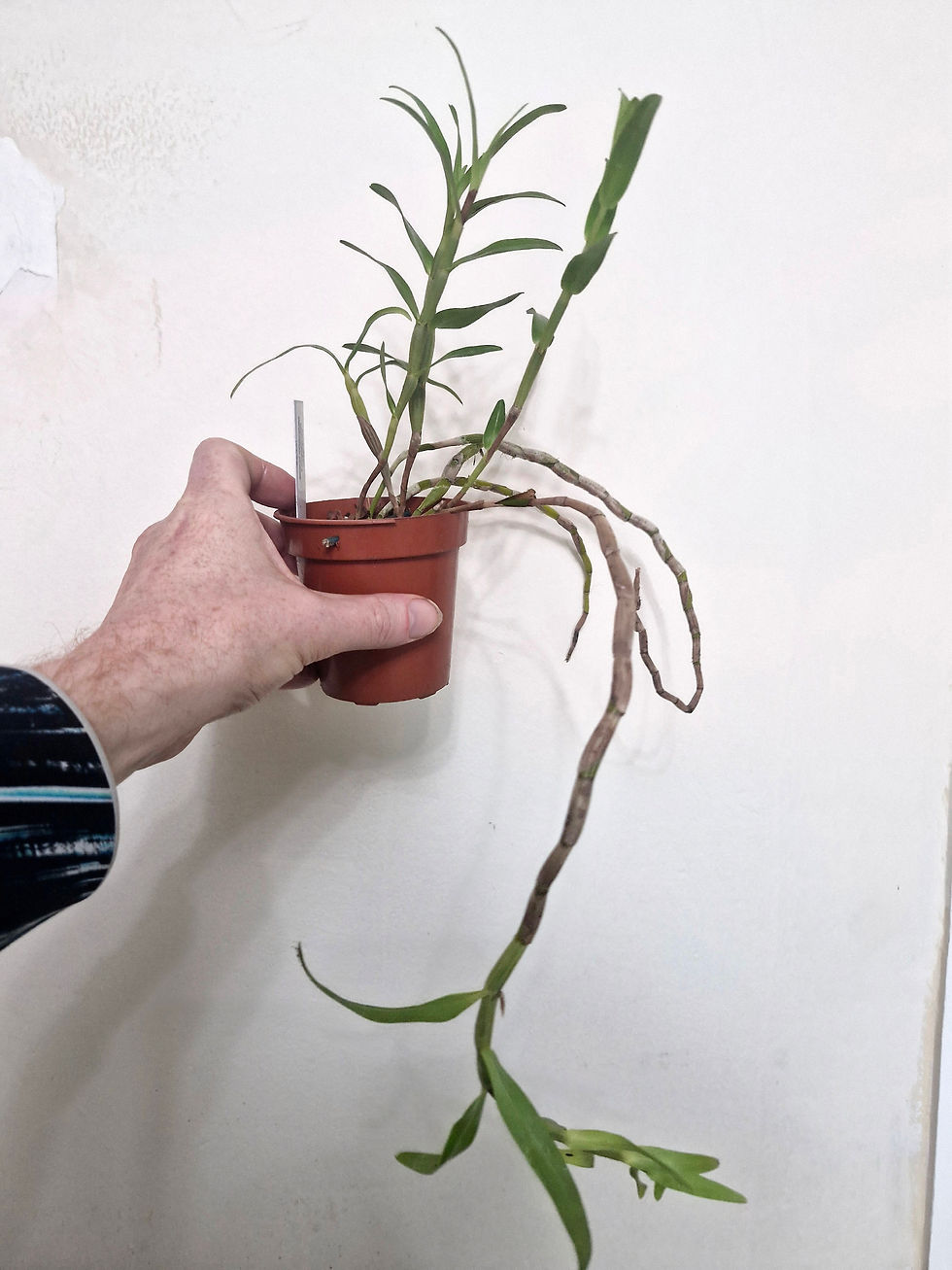
Plant Size: Divisions produced by us in the UK. Plants in 5-7 cm pots and 10 cm + long.
Plant Family: Marcgraviaceae
Plant Passport: A Marcgravia rectiflora B 140084 C [buyer to use number of the plant label] D GB