🌏 Habitat and Ecology
Agapetes neriifolia, commonly known as the Oleander-Leaf Lantern Flower, is an exceptional epiphytic or lithophytic shrub native to the subtropical and wet temperate montane biomes of the eastern Himalayas. Its wild distribution spans northeastern India (such as Meghalaya and Assam), Bhutan, Myanmar, and southwestern China (Yunnan).
Thriving at elevations ranging from 900 to 1800 metres, it is primarily found in evergreen broadleaf forests. It establishes itself high up in mossy tree forks or on shaded, humid rocky cliffs, where it benefits from constant mist, high rainfall, and cool forest breezes.
🌿 Description and Distinguishing Features
This highly architectural member of the Ericaceae family is a sought-after gem for rare plant enthusiasts, combining stunning structural growth with intricate, geometric blooms.
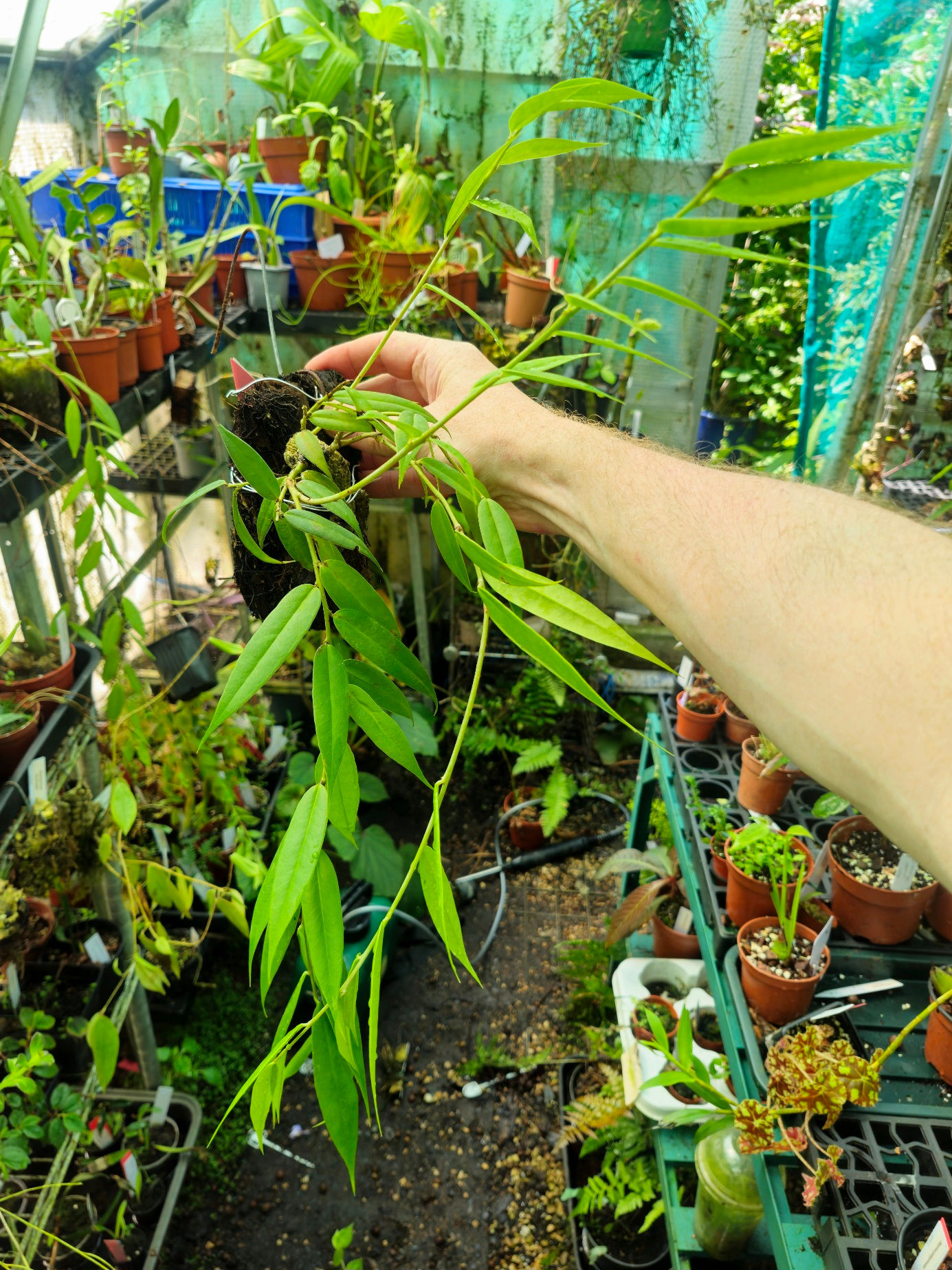
Habit & Caudex: It grows as a semi-pendulous or arching evergreen shrub. At its base, it develops a swollen, woody caudex (lignotuber) that clings tenaciously to bark or rocks and functions as a water storage organ.
Foliage: The specific epithet neriifolia translates directly to "oleander-leaved." This refers to its long, narrow, lanceolate leaves, which are dark green, highly leathery (coriaceous), and smooth with slightly turned-under margins.
Flowers: The spectacular flowers hang in pendulous clusters from the woody branches. They are tubular or lantern-shaped, predominantly a vivid coral-red to rose-pink, and decorated with stunning, dark red chevron or V-shaped geometric patterns. The tips of the petals curl outward slightly to reveal a lighter inner lining, creating a highly detailed, ornamental look.
🔬 Taxonomy and Ethnobotany
Taxonomy
According to Kew Plants of the World Online (POWO), the accepted scientific name is Agapetes neriifolia (King & Prain) Airy Shaw. It belongs to the heath family, Ericaceae, under the tribe Vaccinieae, making it a close relative of both Macleania and the common blueberry.
Ethnobotany
There are no major recorded traditional or commercial uses for this species. It is cultivated strictly as an elite, premium ornamental subject. For specialized collectors, it represents the epitome of Himalayan cloud forest flora—architectural, historically fascinating, and highly distinct from more common cultivated shrubs.
💧 Cultivation and Care
As a high-humidity, cloud forest epiphyte with a woody caudex, Agapetes neriifolia demands highly aerated roots and intermediate-to-cool temperatures to thrive.
Light: Requires bright, filtered indirect light or dappled shade. It loves a well-lit position to encourage heavy blooming, but direct, harsh summer sun will quickly scorch its foliage and dry out the root zone.
Substrate & Soil: Must have an open, acidic (pH 4.5–5.5), and fast-draining medium. A premium mix consisting of medium-grade orchid bark, coarse perlite, and a generous portion of high-quality New Zealand sphagnum moss is ideal. It is highly successful when grown in hanging baskets, net pots, or mounted on cork.
Temperature: It is an intermediate-to-cool grower that appreciates a marked difference between day and night temperatures.
Daytime Range: 18–24°C (64–75°F).
Nighttime Range: 10–15°C (50–59°F). It tolerates cooler winter drops, but should be protected from hard frost.
Watering & Humidity: High ambient humidity (65% to 80%+) is essential. Keep the potting substrate evenly and consistently moist, especially during active growth in spring and summer. Always use pure rainwater or reverse osmosis (RO) water, as it is highly sensitive to the mineral salts and chlorine present in typical tap water.
🏷️ Specifications
Plant Size: As pictured, this is a one and only offer of our stock plant
Plant Family: Ericaceae
Plant Passport: A Agapetes neriifolia B 140084 C use the number written on the plant label D GB