🌏 Habitat and Ecology
Dendrochilum diabloviride (botanically currently accepted as Coelogyne diabloviridis) is an extremely rare and fascinating epiphytic orchid endemic to the island of Samar in the eastern Visayas region of the Philippines. Unlike many high-altitude montane members of the genus, this species is a true lowland-to-intermediate grower. It was discovered growing in brightly lit, humid tropical forest environments at relatively low elevations of approximately 400 metres above sea level, where it receives high ambient warmth and continuous moisture.
🌿 Description and Distinguishing Features
Known affectionately in the trade as the "Green Devil" orchid, this compact-to-medium species is highly sought after by collectors for its unique botanical morphology and striking floral presentation.
Habit & Pseudobulbs: It exhibits an upright, sympodial growth habit with clustered, ovate pseudobulbs that grow up to 2 cm long on a short-creeping rhizome.
Foliage: Each pseudobulb is unifoliate, bearing a single, apical, narrowly lanceolate leaf that measures between 20 and 50 cm in length, featuring a prominent, distinct midrib running down its length.
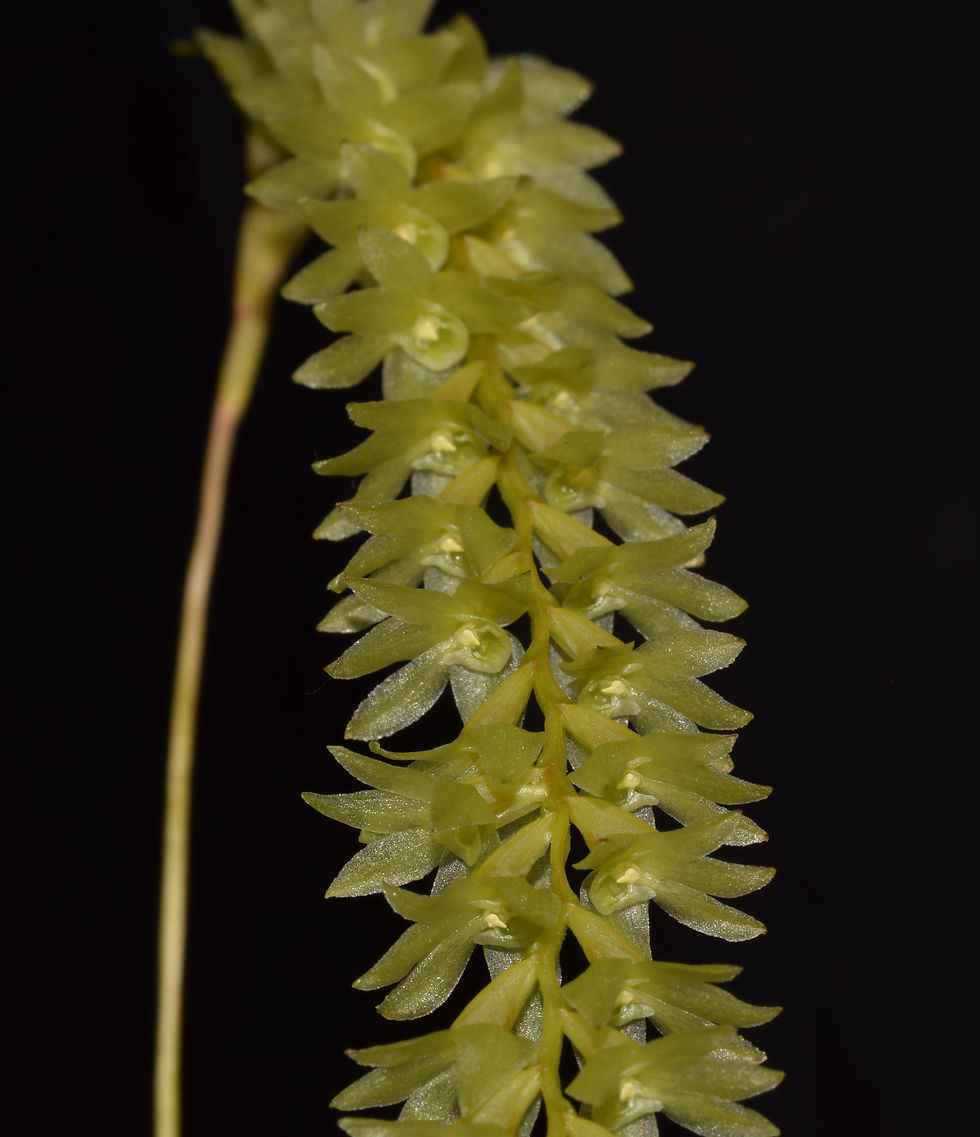
Flowers: The inflorescences emerge alongside new growth, producing a gracefully arching rachis up to 20 cm long that bears approximately 70 closely packed, star-shaped flowers.
The "Green Devil" Lip: The blooms measure roughly 12 mm across and are a solid, bright green color. The most dramatic distinguishing feature of this species is its tiny, circular labellum (lip), which possesses two prominent, upward-pointing, horn-like green projections at its center—the exact trait that earned the plant its devilish name. Unlike many other species in the genus, the flowers of Dendrochilum diabloviride are odourless.
🔬 Taxonomy and Ethnobotany
Taxonomy
According to Kew Plants of the World Online (POWO), the accepted scientific name for this species is Coelogyne diabloviridis (Cootes & R.Boos) M.W.Chase & Schuit.. It was originally described and published in 2013 under the name Dendrochilum diabloviride by the renowned orchidologists Jim Cootes and Ronny Boos. Following comprehensive genetic revisions of the Coelogyninae subtribe in 2021, the entire genus Dendrochilum was transferred into a broader definition of Coelogyne.
Ethnobotany
There are no recorded traditional or ethnobotanical uses for this highly localized species. It is cultivated strictly as an ultra-premium collector's item, highly valued by specialist growers for its incredible visual features and its prestigious status as a newly introduced Philippine endemic.
💧 Cultivation and Care
Because it originates from warm, lowland Philippine forests rather than high-altitude cloud forests, Dendrochilum diabloviride is significantly more heat-tolerant and adaptable than many of its cool-growing relatives.
Light: Requires medium-to-bright, filtered indirect light. It thrives in well-lit conditions (similar to cattleya-type orchids) but must be shaded from direct, midday summer sun to prevent bleaching or scorching the long, narrow leaves.
Substrate & Soil: Demands a highly aerated, fast-draining, yet moisture-retentive potting medium. A premium mix of fine-to-medium grade orchid bark, coarse perlite, and a generous portion of high-quality New Zealand sphagnum moss is ideal. It grows exceptionally well in shallow pots or slatted wooden baskets that accommodate its short, clumping rhizome.
Temperature: This is a warm-to-intermediate grower that is perfectly suited to standard home climates or warm greenhouses.
Daytime Range: 21–29°C (70–84°F).
Nighttime Range: 16–21°C (61–70°F). Unlike highland species, it does not require a severe temperature drop at night to thrive.
Watering & Humidity: High humidity (65% to 80%+) is essential. The fine, fibrous root system must never be allowed to dry out completely. Water regularly to keep the medium evenly and consistently moist, particularly during the active spring and summer growing seasons. Always use pure rainwater or reverse osmosis (RO) water, as its sensitive root tips can quickly burn from the mineral buildup found in tap water.
🏷️ Specifications
Plant Size: as pictured. This is our stock plant
Plant Family: Orchidaceae
Plant Passport: A Dendrochilum diabloviride B 140084 C use the number written on the plant label D GB