🌏 Habitat and Ecology
Ceratostema gualaquizensis is a highly localized epiphytic shrub belonging to the Andean blueberry family (Ericaceae). It is endemic to the superhumid montane cloud forests of south-eastern Ecuador, specifically within the Morona-Santiago province along the Cordillera Real near the township of Gualaquiza.
Thriving at elevations around 1,300 to 2,000 metres, this extraordinary species grows tucked away in the upper branches of primary forest trees or on relict canopy trees bordering high-altitude pastures. It has evolved to thrive in environments defined by perpetual, cool mountain mists, high atmospheric humidity, and steady, gentle air currents that sweep through the Andean foothills.
🌿 Description and Distinguishing Features
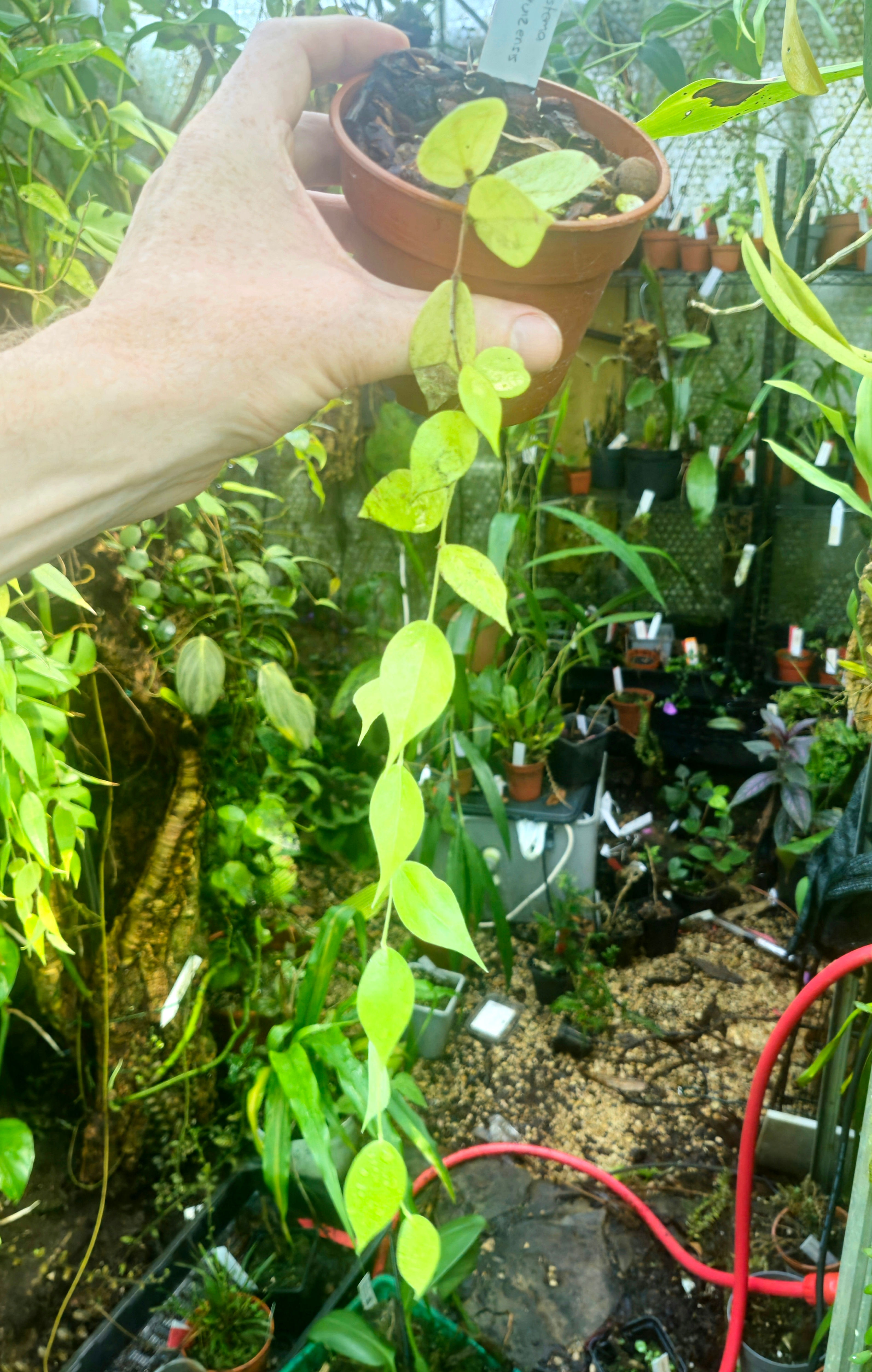
This elegant, pendent shrub grows from a well-developed, woody lignotuber, throwing out long, slender, trailing branches that create a beautiful weeping silhouette. It is highly prized by advanced collectors of rare Ericaceae for both its striking foliage geometry and its intensely colored, alien-looking blossoms.
Foliage: The younger branches are terete to filiform, extremely slender, and finely cloaked in soft, tiny white hairs (tomentose). The leaves are small, leathery (coriaceous), and elliptic. They are distinctly convex, curving gently downward, and possess characteristic involute (inwardly folded) margins right at the leaf base.
Flowers: The inflorescences are borne solitarily in the leaf axils on short, delicate stalks. The flowers themselves are heavily textured, thick, and tubular, featuring a slightly 5-ribbed corolla tube.
Floral Coloration: The blooms provide a masterclass in natural contrast. The main body of the tube is a brilliant, glowing magenta-pink or crimson. This vivid tube terminates in sharply spreading, narrowly linear-triangular lobes that are jet-black or deep charcoal at the tips, creating a dramatic and instantly recognizable bicolored display.
🔬 Taxonomy and Ethnobotany
Taxonomy
According to Kew and formal botanical literature, the accepted scientific name for this species is Ceratostema gualaquizensis M.M.Jiménez & H.Garzón. Formally described in November 2024 in the journal Phytotaxa, it belongs to the family Ericaceae, subfamily Vaccinioideae, and tribe Vaccinieae.
Prior to its formal publication, specimens of this plant in international cultivation were widely misidentified and traded under various fictitious or temporary nursery names. Currently, minor recognized variations exist within cultivation and field studies, such as the standard type form, the wavy-edged var. laciniata, the elongated var. tubularis, and the highly lustrous var. lucida.
Ethnobotany
There are no recorded traditional medicinal, culinary, or economic uses documented for Ceratostema gualaquizensis within its restricted native range. Its value is entirely horticultural and scientific. As one of the most recently cataloged and coveted Andean Ericaceae species, it represents a high-prestige botanical acquisition, sought after by specialized institutions and advanced collectors dedicated to preserving high-altitude cloud forest biodiversity.
💧 Cultivation and Care
Given its high-elevation Andean cloud forest lineage, Ceratostema gualaquizensis behaves as a obligate cool-to-intermediate grower and will rapidly decline if subjected to stagnant, dry, or excessively hot lowland environments.
Light: Requires bright, filtered indirect light or dappled shade, closely mimicking the conditions found within a protective upper forest canopy. Strong artificial LED lighting or shaded greenhouse positions are ideal, but the delicate foliage must be entirely shielded from direct midday sun to prevent bleaching and severe leaf scorch.
Substrate & Soil: Demands a highly porous, chunky, and distinctly acidic medium (pH below 6.0) that permits exceptional drainage while retaining light, uniform moisture. An ideal epiphytic mix consists of premium New Zealand sphagnum moss, fine-to-medium orchid bark, tree fern fiber, and a generous amount of coarse perlite.
Temperature: Cultivated strictly under a cool-to-intermediate temperature regime.
Daytime Range: 18–25°C (64–77°F). Ensure temperatures do not remain pinned above 28°C (82°F) for prolonged summer periods.
Nighttime Range: 10–16°C (50–61°F). A distinct, sharp drop in nocturnal temperature is highly critical for maintaining plant vigor and encouraging long-term foliage health.
Watering & Humidity: High atmospheric humidity (70% to 85%+) combined with constant, gentle air movement is mandatory to keep the unique convex leaves from drying out or suffering from marginal browning. The potting substrate must be kept evenly and consistently moist year-round—never allow the root zone to dry out completely, but ensure it never sits in soggy, waterlogged, or anaerobic water columns. Always water with pure rainwater, distilled, or reverse osmosis (RO) water, as the fine root systems are highly sensitive to dissolved salts, tap water additives, and hard minerals. Feed very sparingly using a highly diluted, balanced liquid ericaceous fertilizer during active seasonal flushes.
🏷️ Specifications
Plant Size: Small Pendent Shrub (Trailing stems roughly 20 to 30 cm)
Plant Family: Ericaceae
Plant Passport: A Ceratostema gualaquizensis B 140084 C use the number written on the plant label D GB