🇨🇳 Habitat and Ecology
Holcoglossum lingulatum is a rare, miniature to small-sized monopodial epiphytic orchid native to the border regions of Southern China (Guangxi, Yunnan) and Northern Vietnam. It is found growing on tree trunks in broad-leaved, evergreen montane forests at elevations typically between 1,000 and 1,400 metres. This species is adapted to a cool-to-intermediate growing regime in the wet tropical/subtropical biome, growing in conditions of high humidity and moderate shade to filtered light.
🌸 Description and Distinguishing Features
This orchid is a compact, evergreen perennial known for its rigid foliage and crystalline flowers.
Foliage: It features a short, woody stem carrying several rigid, fleshy, terete (cylindrical) or semi-terete leaves. The leaves are dark green, channelled, and often arch gracefully, usually measuring 10-20 cm long.
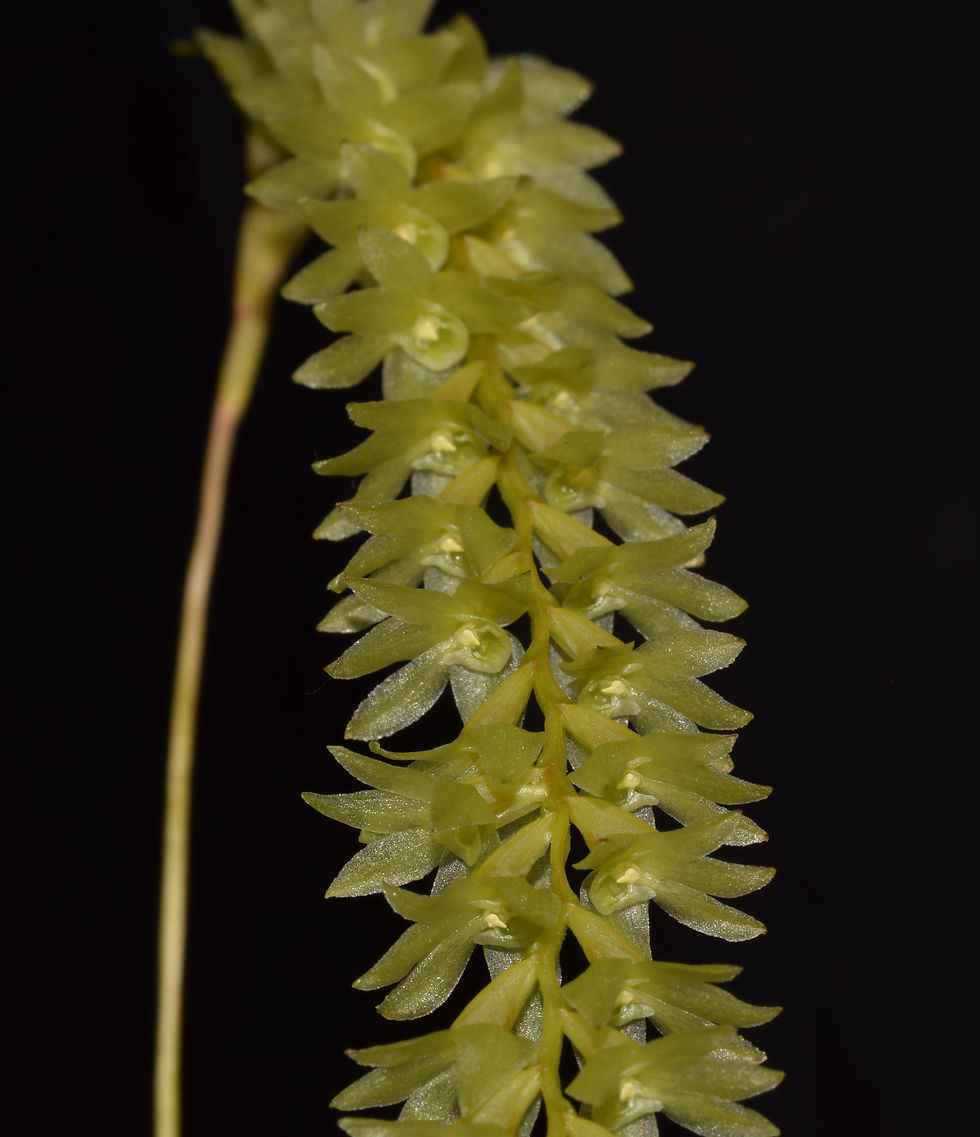
Flowers: The flowers are produced on short, axillary spikes (racemes) that carry 1 to 5 blooms, typically appearing in autumn or winter. The blooms are approximately 1.5–2.5 cm wide.
Aesthetics: The flowers are typically pure white, with a texture often described as crystalline. The defining feature, referenced by the specific epithet lingulatum (meaning 'tongue-shaped'), is the prominent, tongue-like lip (labellum). The lip is white, often marked with a yellow, ochre, or brownish-orange callus near the base, and possesses a distinct spur.
Ethnobotany: While specific ethnobotanical uses for H. lingulatum are not widely documented, the genus Holcoglossum is closely related to Vanda, and related species are sometimes cultivated for their ornamental value in East Asian horticulture.
Differentiation:
Versus Holcoglossum wangii: H. wangii is very similar but generally has more flowers per spike and the lip often shows pinkish or purple spotting/margins, whereas H. lingulatum is typically cleaner white with yellow/ochre markings and a narrower lip.
Versus Holcoglossum kimballianum: H. kimballianum is a much larger plant with significantly larger flowers (4-5 cm) that usually feature distinct purple/red veins on the lip, absent in H. lingulatum.
💧 Cultivation and Care
Holcoglossum lingulatum is a cool-to-intermediate growing orchid that requires excellent drainage and air circulation.
Light: Needs bright, filtered light. While the terete leaves suggest high light tolerance, it prefers slightly more shade than the extremely high-light H. kimballianum.
Substrate: It is best grown mounted on cork bark or in a slatted wooden basket with very coarse media (charcoal/large bark) to allow roots to dry rapidly after watering. It resents having "wet feet."
Watering: Water regularly and abundantly during the active growing season (spring/summer). Reduce watering in the winter to provide a slight rest, watering just enough to prevent the fleshy leaves from shrivelling.
Temperature:
Optimal Daytime Temperature: 18-25 C (64-77 F).
Optimal Nighttime Temperature: A cool drop is beneficial, ideally 10-15 C (50-59 F).
Humidity: High humidity (60-80%) with strong air movement is critical to prevent rot in the leaf axils.
✨ Unique Features
Holcoglossum lingulatum is a collector's miniature prized for its pristine white, tongue-lipped flowers and its neat, terete foliage. Its compact habit makes it ideal for small spaces, and the crystalline texture of the blooms gives it a delicate, frosty appearance that contrasts beautifully with the rigid, dark green leaves.
🏷️ Specifications
Plant Size: Recently deflasked, plants on mounts and 10 cm
Plant Family: Orchidaceae
Plant Passport: A Holcoglossum lingulatum B 140084 C [buyer to use number of the plant label] D GB