🇨🇳 Habitat and Ecology
Holcoglossum subulifolium (often known as the Awl-Leaved Holcoglossum) is a small, semi-pendent epiphytic orchid native to Southern China (Hainan, Yunnan) and Indochina. Its range extends through Vietnam, Laos, Thailand, and Myanmar. It thrives in primary montane forests at elevations ranging from 800 to 1,600 metres, often growing on tree trunks in dappled light beneath the canopy. This species is adapted to a cool-to-intermediate growing regime with consistently high humidity and distinct seasonal variations.
🌸 Description and Distinguishing Features
This orchid is a monopodial perennial distinguished by its needle-like foliage and crystalline blooms.
Foliage: It produces slender, pendent or arching stems carrying numerous terete (cylindrical) to awl-shaped leaves. The leaves are fleshy, dark green, and pointed, typically measuring 3-14 cm long.
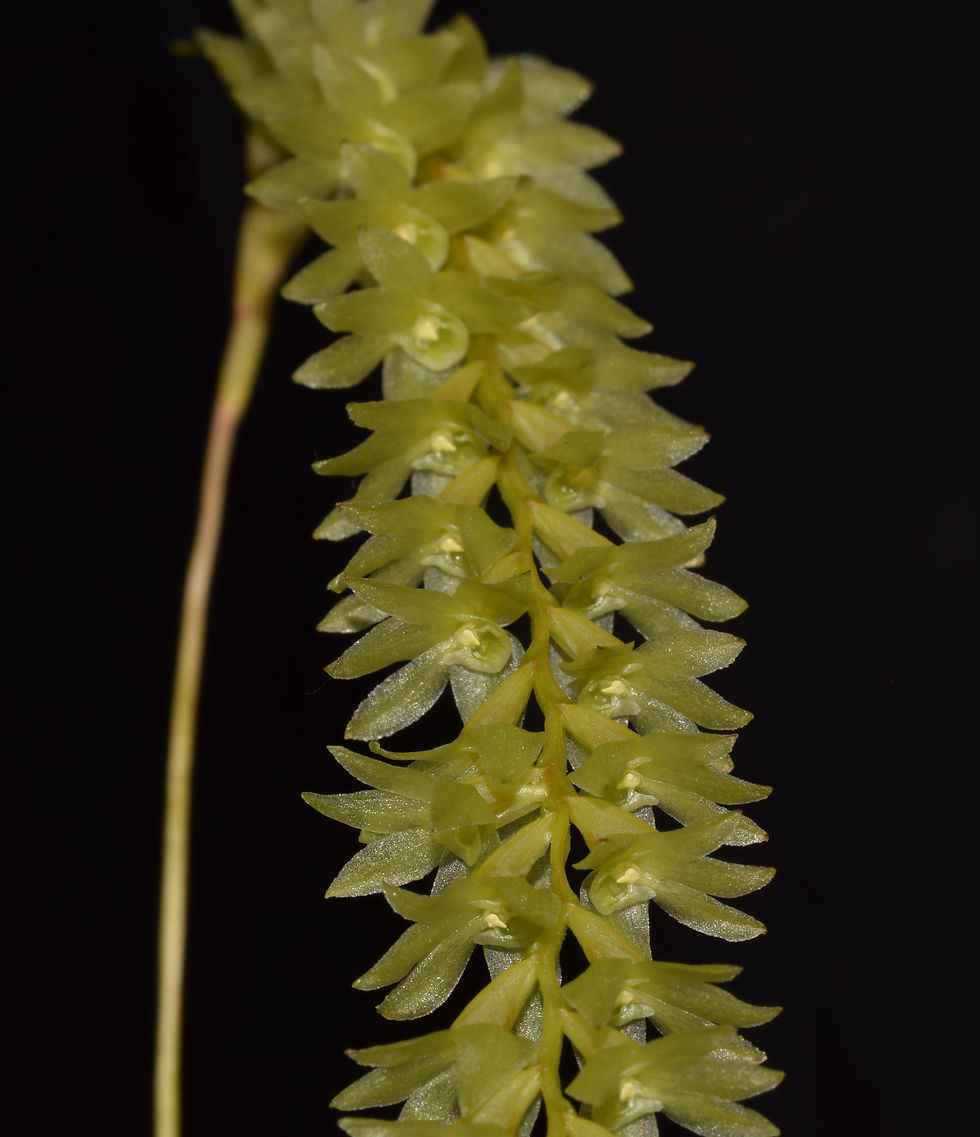
Flowers: The flowers are borne on arching to pendent, often branching spikes (racemes) that can reach up to 30-75 cm long. The spike carries numerous (10-15) delicate flowers, typically blooming in spring.
Aesthetics: The blooms are approximately 4 cm (1.5 inches) wide and possess a thin, crystalline texture. They are typically pure white with a prominent anchor-shaped lip. The lip features a distinctive bright yellow, orange, or ochre throat (callus) and widely spreading side lobes, contrasting sharply with the white petals. The flowers are subtly fragrant.
Ethnobotany: While specific ethnobotanical records for H. subulifolium are limited, related species in the Vanda alliance are historically used in Traditional Chinese Medicine (TCM) for their anti-inflammatory properties and as tonics.
Differentiation:
Versus H. kimballianum: H. kimballianum has larger flowers (5-6 cm) with a lip that is typically marked with distinct purple or magenta veins and fringed margins, unlike the yellow-throated, white lip of H. subulifolium.
Versus H. amesianum: H. amesianum is a more robust plant with white to pale pink flowers that are often more fragrant and fleshy than the thin, crystalline blooms of H. subulifolium.
💧 Cultivation and Care
Holcoglossum subulifolium is a rewarding intermediate-growing orchid best suited for hanging culture due to its pendent habit.
Light: Requires bright, filtered light (22,000-32,000 lux). Provide ample light similar to Vanda but protect from direct scorching sun.
Substrate: Best grown mounted on cork bark or in a wooden basket to accommodate its hanging stems and aerial roots. Use a coarse, well-draining mix if potted (charcoal, large bark).
Watering: Water regularly and frequently (3-5 times a week) during the active growing season (spring/summer), allowing the roots to dry slightly between waterings. Reduce watering in winter to provide a slight rest, but do not allow it to dry out completely.
Temperature:
Optimal Daytime Temperature: 18-26 C (65-79 F).
Optimal Nighttime Temperature: A cool drop is beneficial, ideally 9-15 C (48-59 F).
Humidity: High humidity (60-80%) with excellent air circulation is mandatory.
✨ Unique Features
This orchid is a collector's favourite for its needle-like, terete foliage and graceful, cascading sprays of crystalline white flowers. The bright yellow-orange throat against the snowy white petals creates a classic, elegant display. Its adaptability to mounted culture makes it a stunning vertical feature for a bright, humid space.
🏷️ Specifications
Plant Size: young plants on mounts. Deflasked recently
Plant Family: Orchidaceae
Plant Passport: A Holcoglossum subulifolium B 140084 C [buyer to use number of the plant label] D GB